
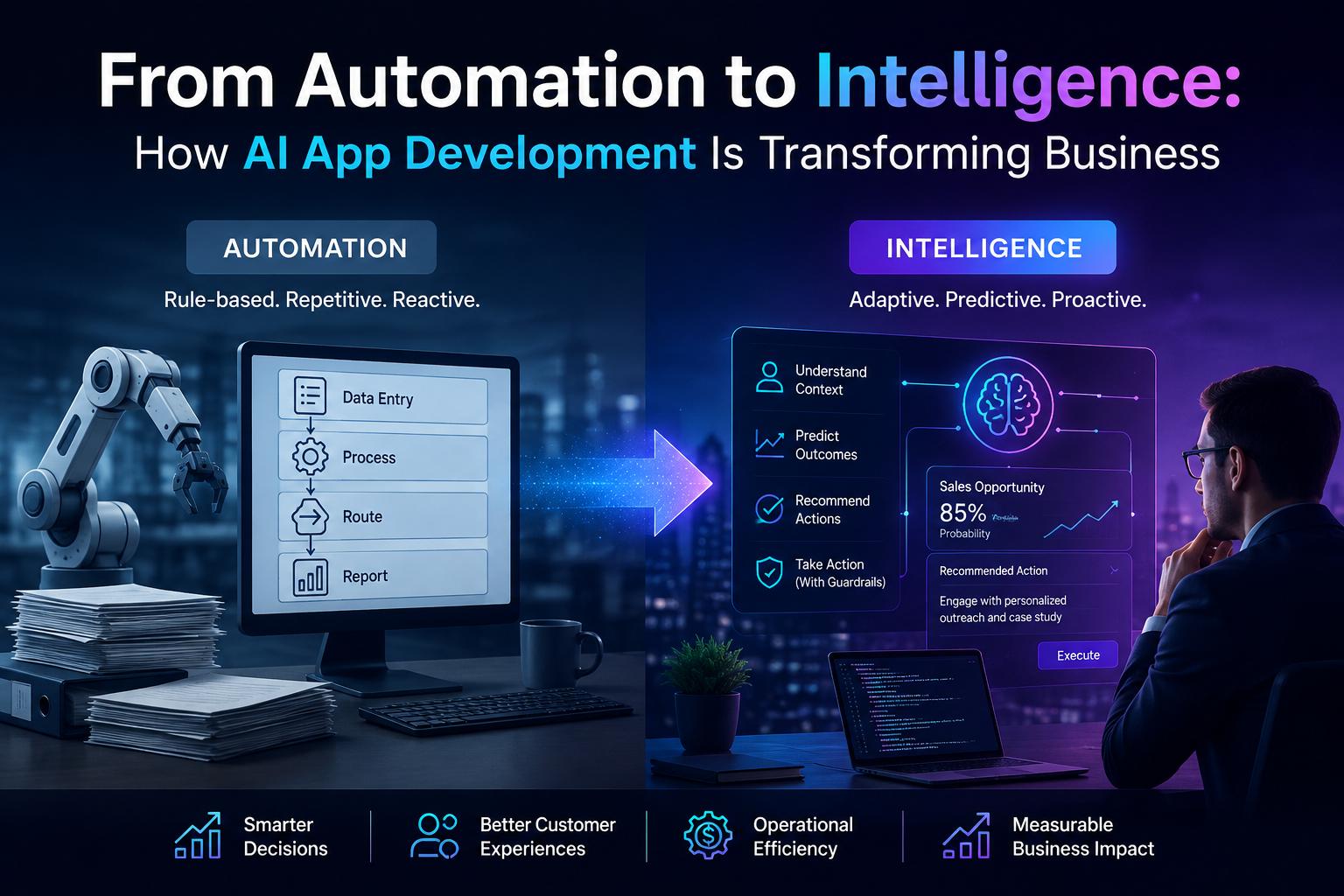
For years, “digital transformation” mostly meant automation -replacing paper forms with apps, manual data entry with workflows, and phone calls with chat widgets. That phase solved efficiency problems but left most decision-making to humans. The next phase looks different. By late 2025, 88% of organizations used AI in at least one business function, yet only about 23% were scaling agentic AI anywhere in the enterprise, and roughly 39% reported measurable profit impact. Businesses working with experienced AI App development in USA are now building applications that don’t just execute fixed rules -they interpret data, predict outcomes, and recommend or take action on their own, often by embedding task-specific AI agents that operate within defined guardrails.
Automation and Intelligence Are Not the Same Thing
Automation follows instructions. If a customer submits a form, an automated system routes it to the right department – every time, the same way, regardless of context. It’s reliable, but it can’t handle a situation the rules didn’t anticipate.
Intelligent systems work differently. They analyse the content of that same form, compare it against historical patterns, flag anomalies, and adjust the response based on what similar cases needed in the past. The difference is judgment, not just speed – and that difference is where most of today’s business value is being created.
Where Businesses Are Feeling the Shift
The transition from automation to intelligence is showing up across nearly every department, not just customer-facing products.
Adoption is widespread, but value is not automatic: in 2025–2026, only about 39% of organizations could link AI use to measurable profit impact, making it critical to focus on high-friction, high-ROI workflows.
Customer Service and Support
Support tools now go beyond scripted chatbots. Modern systems read the full context of a customer’s history, tone, and prior tickets before responding, escalating to a human only when the situation genuinely requires one.
Sales and Lead Qualification
Instead of scoring leads with a fixed point system, intelligent sales tools weigh dozens of behavioural and firmographic signals simultaneously, adjusting priority as new data comes in throughout the day.
Operations and Supply Chain
Inventory and logistics platforms increasingly forecast disruptions – a delayed shipment, a demand spike – before they happen, rather than simply reporting problems after they’ve already affected the business.
Finance and Reporting
Expense monitoring and financial reporting tools now flag unusual patterns in real time and generate plain-language summaries for non-finance stakeholders, cutting down the manual review work analysts used to handle.
Moving a single department from automated workflows to genuine intelligence is rarely a plug-and-play upgrade. Teams built around skilled AI app development professionals in the USA usually start with the workflow generating the most manual effort, since that’s where an intelligent system produces the clearest, fastest return.
What Makes a Business App Genuinely Intelligent
For business use, a recommendation without reasoning is hard to trust. Well-built systems surface why they flagged a transaction or prioritised a lead, giving teams a way to verify and override when needed. This is increasingly a compliance requirement: regulators in the EU and several U.S. states began requiring explanations for high-stakes AI decisions in 2025, particularly in finance, healthcare, and other regulated domains.
Learning From Outcomes, Not Just Inputs
An intelligent app tracks whether its past recommendations actually worked and adjusts future behaviour accordingly, rather than repeating the same logic regardless of results.
Handling Ambiguity Gracefully
Real business data is messy – incomplete records, inconsistent formatting, conflicting inputs. Intelligent systems are designed to make reasonable judgments under that uncertainty instead of failing or defaulting to a generic response.
Explaining Its Own Decisions
For business use, a recommendation without reasoning is hard to trust. Well-built systems surface why they flagged a transaction or prioritised a lead, giving teams a way to verify and override when needed.
Building an Intelligent App: The Practical Path
Businesses that succeed with this shift tend to follow a similar sequence, regardless of industry.
Start With One High-Friction Process
Rather than rebuilding an entire platform, most successful projects begin with a single bottleneck – the process eating the most staff hours or causing the most customer complaints.
Use Existing Data Before Collecting New Data
Years of historical tickets, transactions, or logs already sitting in company systems are usually enough to train an effective first model, avoiding the delay of building a new data pipeline from scratch.
Pilot With a Small, Measurable Scope
A limited rollout – one team, one region, or one product line – makes it far easier to measure real impact and fix issues before a company-wide deployment.
Keep a Human in the Loop Early On
Early-stage intelligent systems perform best when paired with human review, which builds trust in the tool while catching edge cases the model hasn’t seen enough of yet.
This staged approach reduces risk considerably compared to a full-scale rollout on day one. Businesses that work with established AI app development experts often see this phased method shorten time-to-value, since each pilot generates real usage data that improves the next stage of the build.
Common Pitfalls Businesses Run Into
The shift from automation to intelligence isn’t without risk, and several recurring mistakes tend to slow projects down.
Treating It as a One-Time IT Project
Intelligent systems need ongoing monitoring and retraining as business conditions change. Teams that treat the launch as the finish line often see performance quietly decline within months.
Underestimating Data Quality Issues
A model trained on inconsistent or outdated records will produce unreliable recommendations no matter how sophisticated the underlying technology is. Data cleanup is often the least glamorous but most important step.
Skipping Change Management
Employees who don’t understand how or why a system makes a recommendation tend to ignore it. Training and clear communication matter as much as the technical build itself.
Measuring Whether the Shift Is Actually Working
Business leaders should track outcomes, not just adoption numbers, to know if an intelligent system is delivering value.
Useful indicators include the reduction in manual review hours, the accuracy of predictions compared against actual outcomes over time, and whether customer or employee satisfaction scores improve after rollout. Vanity metrics like raw usage counts rarely tell the full story on their own.
Frequently Asked Questions
What’s the difference between business automation and business intelligence software?
Automation executes fixed rules consistently but can’t adapt to new situations. Intelligent software analyses data, learns from outcomes, and adjusts its recommendations or actions as new information comes in.
How long does it take to see ROI from an AI-powered business app?
Focused pilots on a single high-friction process often show measurable results within 8 to 12 weeks, while enterprise-wide rollouts across multiple departments typically take six months or longer to fully mature.
Do small businesses actually benefit from AI app development, or is it only for large enterprises?
Small businesses often see faster, more visible returns because they can pilot a single workflow – like lead scoring or support triage – without the complexity of coordinating across large teams.
What data do businesses need before starting an AI project?
Most companies already have enough historical data in existing systems – support tickets, sales records, transaction logs – to begin a first pilot without needing to collect new data upfront.
Is it risky to let AI systems make business decisions automatically?
Risk is manageable when systems are deployed with human oversight, clear escalation rules, and ongoing monitoring, particularly for high-stakes decisions in finance, healthcare, or compliance-sensitive areas.
Final Thoughts: Intelligence Is Becoming the New Baseline
Automation solved yesterday’s efficiency problems, but it can’t keep pace with how quickly business conditions change today. Companies moving toward genuine intelligence-systems that learn, adapt, and explain their reasoning-can build a meaningful advantage over competitors still relying on fixed workflows.
Curious what this could look like for your business? Contact us today to discuss your goals and identify the right starting point for your team.