Table of Contents
- Introduction
- Why AI App Development Is Becoming a Competitive Advantage
- What AI App Development in USA Offers Modern Businesses
- Business Challenges AI Applications Can Solve
- Essential Technologies Behind Successful AI Apps
- Choosing the Right AI App Development Partner
- Future-Proofing Your Business Through AI Innovation
- Final Thoughts
- Frequently Asked Questions
1. Introduction
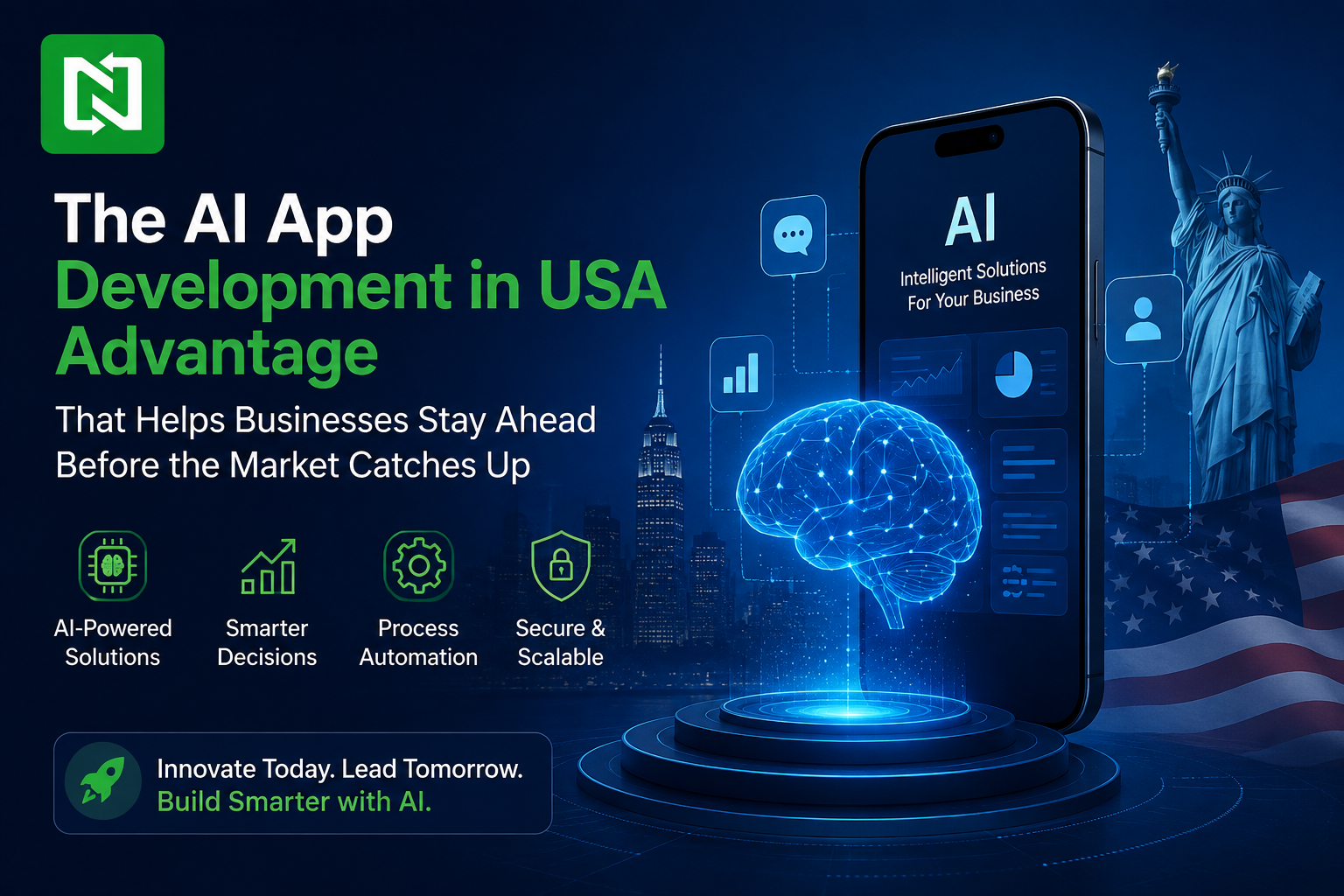
For years, artificial intelligence was treated as an experimental add-on, something businesses explored to look innovative rather than something that changed how they actually operated. That has shifted quickly. AI App Development in USA has become a genuine business advantage, not simply an innovation initiative sitting on a slide deck. Companies that build AI capability into their core applications are automating repetitive work, making faster and better-informed decisions, and creating customer experiences that competitors relying on legacy systems simply cannot match. The productivity gains alone are significant, but the deeper shift is strategic: businesses that treat AI as infrastructure rather than experimentation are positioning themselves to move faster than the market for years to come, while those that delay risk playing catch-up against competitors who moved early. This shift is not limited to large enterprises with dedicated data science teams. Mid-sized companies across retail, healthcare, logistics, and professional services are finding that well-built AI applications deliver measurable returns within months, not years, which is reshaping how leadership teams think about technology budgets and where they choose to invest first.
2. Why AI App Development Is Becoming a Competitive Advantage
Rising Customer Expectations
Customers now expect instant, relevant responses, whether they are chatting with support, browsing recommendations, or completing a transaction. Businesses that fail to meet these expectations lose customers to competitors who can, often without ever knowing why engagement dropped. What once felt like a convenience, instant answers and personalized recommendations, has quietly become the baseline customers judge every interaction against, regardless of company size or industry.
Faster Business Decisions
AI systems can process and summarize information far faster than manual analysis, giving leadership teams real-time insight instead of outdated reports. This speed allows businesses to respond to market shifts while the opportunity is still open, rather than after it has closed.
Operational Efficiency
Repetitive tasks that once required significant staff time, from data entry to routine customer queries, can now be automated reliably. This frees employees to focus on higher-value work while reducing the operational costs tied to manual processes. Over time, the cumulative savings from even modest automation gains often exceed the initial cost of building the application, making efficiency one of the clearest and most measurable returns on an AI investment.
3. What AI App Development in USA Offers Modern Businesses
Custom AI Solutions
Off-the-shelf tools rarely fit a business perfectly. Custom development tailors AI models and workflows to a company’s specific data, customers, and processes, producing results that generic solutions cannot match.
Scalable AI Integration
Modern AI applications are built on cloud infrastructure that can expand as usage grows, without the business needing to rebuild its systems every time demand increases. This scalability keeps costs predictable even as adoption accelerates.
Secure Development Practices
Responsible AI development takes compliance and data protection seriously from the start. Enterprise scalability means little if it comes at the cost of security, so professional teams build governance and safeguards into the architecture rather than treating them as an afterthought. This includes clear data handling policies, access controls, and audit trails that satisfy both internal risk teams and external regulatory requirements as the application scales across departments or regions.
4. Business Challenges AI Applications Can Solve
Improving Customer Support
AI-driven support tools can handle common questions instantly, escalate complex issues to human agents seamlessly, and operate around the clock. A retail business, for example, might use these enterprise AI solutions to resolve routine order inquiries at any hour without adding overnight staff.
Optimizing Operations
From inventory forecasting to scheduling, AI can identify patterns in operational data that humans would take far longer to notice, allowing businesses to reduce waste and improve efficiency across supply chains and internal workflows. A logistics company, for instance, might use predictive models to anticipate delivery delays before they happen, adjusting routes proactively instead of reacting after customers have already been affected.
Enhancing Decision Making
By surfacing trends and anomalies in real time, AI applications give decision-makers a clearer picture of what is actually happening in the business, rather than a delayed summary based on last month’s numbers.
5. Essential Technologies Behind Successful AI Apps
Machine Learning
Machine learning allows systems to improve their predictions and recommendations over time as they process more data, making them increasingly accurate the longer they operate within a business, whether that means better fraud detection, more relevant product recommendations, or more precise demand forecasting.
Generative AI
Generative AI creates content, summaries, and responses on demand, powering everything from customer-facing chat assistants to internal tools that draft reports and documentation in a fraction of the time manual work would take.
Natural Language Processing
Natural language processing allows applications to understand and respond to human language naturally, which is what makes chatbots, voice assistants, and document analysis tools feel conversational rather than mechanical.
6. Choosing the Right AI App Development Partner
Technical Capabilities
Not every development team has genuine AI expertise. Evaluating a partner’s experience with generative AI development, machine learning applications, and secure deployment practices helps separate teams that truly understand the technology from those simply following trends. Asking for concrete examples of past deployments, including how they handled scaling and security, usually reveals more than any marketing material a vendor might present.
Industry Knowledge
A partner who understands your industry’s specific regulations, customer behavior, and operational challenges can build solutions that fit real-world constraints, rather than generic models that need significant rework to become useful.
End-to-End Development Support
Strategy, deployment, optimization, and ongoing support should come from a single accountable partner. Fragmented development across multiple vendors often creates integration problems and unclear ownership when something needs fixing. A single partner who understands the full lifecycle of the application, from initial strategy through ongoing optimization, can move faster and troubleshoot issues without the delays that come from coordinating across disconnected teams.
7. Future-Proofing Your Business Through AI Innovation
Continuous Learning Systems
The strongest AI applications are designed to keep learning from new data, improving their accuracy and relevance over time instead of remaining static from the day they launch.
Scalable Digital Transformation
AI adoption works best as part of a broader digital transformation strategy, one where new capabilities integrate cleanly with existing systems rather than existing as an isolated experiment disconnected from daily operations.
Staying Ahead of Market Changes
Businesses that build flexible AI infrastructure now are better positioned to adapt when market conditions shift, since their systems are already designed to absorb new data sources, models, and use cases without a complete overhaul. This adaptability often matters more than any single feature, because the businesses that struggle most during periods of rapid change are usually the ones locked into rigid systems built for conditions that no longer exist.
8. Final Thoughts
AI App Development in USA is no longer a bet on future technology; it is a practical way to build sustainable innovation and lasting competitive growth today. Businesses that invest in custom application development services now are creating infrastructure that compounds in value as their data, customer base, and operational complexity grow. Those that wait risk trying to retrofit AI into systems that were never designed for it, a far more expensive path than building it in from the start. The businesses moving fastest right now are not necessarily the largest ones; they are the ones willing to treat AI as core infrastructure rather than a side project, and to choose a development partner capable of executing that vision reliably. If your business is ready to explore what AI can do for your operations and customer experience, contact our AI experts to discuss where the opportunity fits best.
9. Frequently Asked Questions
Why is AI App Development in USA becoming important for businesses?
It allows companies to automate routine work, make faster decisions based on real-time data, and deliver customer experiences that keep pace with rising expectations, all of which directly affect competitiveness and cost efficiency.
Which industries benefit most from AI applications?
Retail, healthcare, finance, logistics, and professional services have all seen significant gains, particularly in customer support automation, operational forecasting, and personalized recommendations, though the underlying benefits apply broadly across most industries.
What should businesses look for in an AI app development company?
Look for proven technical expertise in machine learning and generative AI, relevant industry experience, transparent communication, and a commitment to secure, compliant development practices rather than generic, one-size-fits-all solutions. Requesting references and reviewing how a vendor supports its applications after launch can reveal just as much as its technical portfolio.