
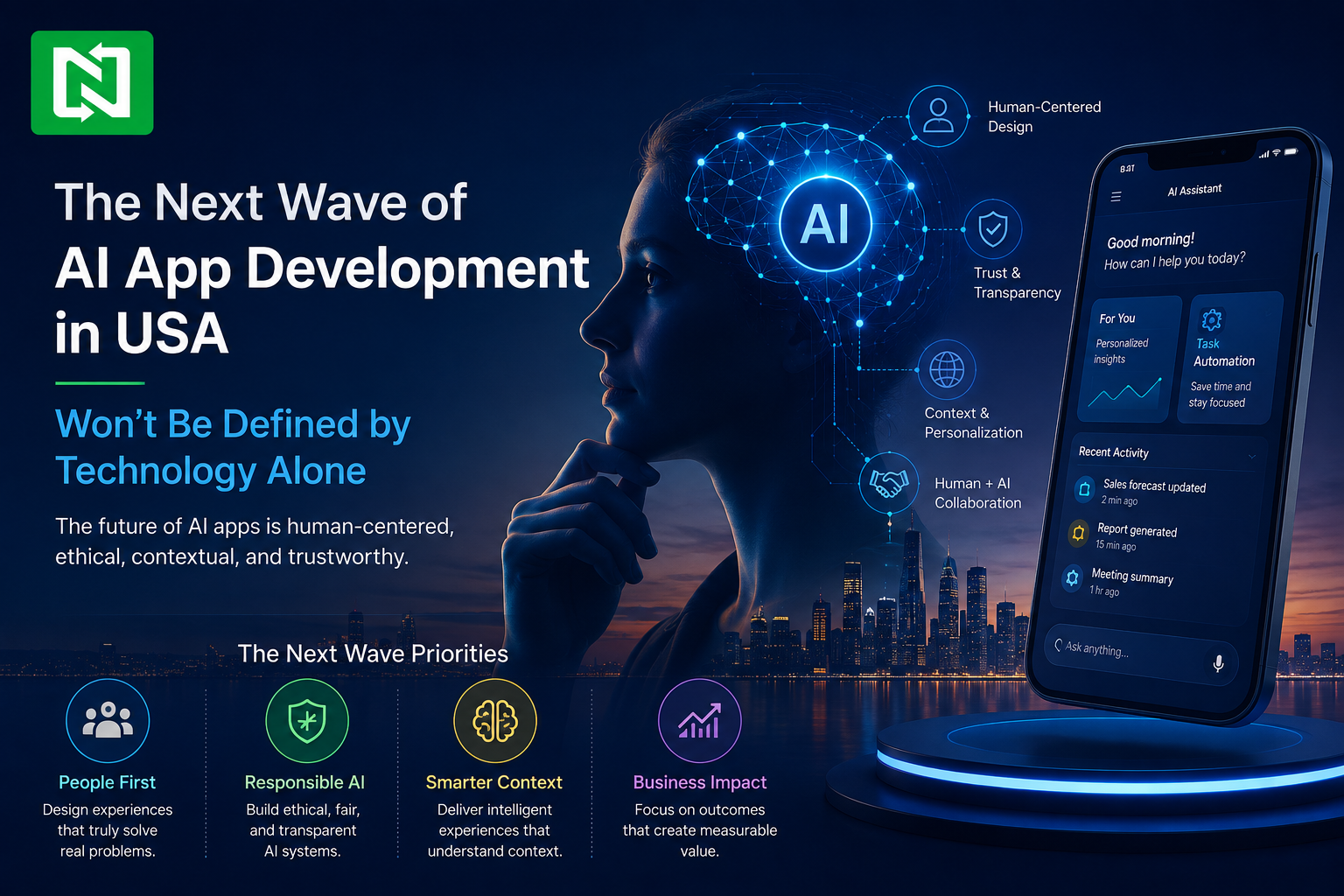
Introduction
Artificial intelligence has moved well past being a purely technological breakthrough. The algorithms themselves have become widely accessible, which means the real differentiator today lies elsewhere: in user experience, trust, ethics, business relevance, and human-centered design. Companies pursuing AI App Development in USA are discovering that technical capability alone rarely determines long-term success. What separates a valuable AI application from a forgettable one is how thoughtfully it is designed around real human needs, how transparently it operates, and how consistently it earns user confidence. As the industry matures, this shift in focus is becoming the defining story of where AI-powered software is headed next.
Why AI Innovation Is Moving Beyond Algorithms
Technology Has Become More Accessible
Widespread AI frameworks, mature cloud AI platforms, and a growing ecosystem of open-source AI tools have lowered the barrier to entry significantly. What once required specialized research teams can now be assembled by small development groups. This democratization of AI means that raw technical capability alone is no longer a meaningful competitive advantage, since most teams have access to comparable underlying tools.
User Experience Creates Competitive Value
With algorithms becoming a commodity, simplicity, usability, and intuitive interfaces have become the real points of differentiation. Reducing complexity for the end user, rather than showcasing technical sophistication, is what determines whether an AI feature actually gets used or quietly ignored.
Business Problems Matter More Than Features
The most durable AI implementations are built around solving meaningful challenges rather than demonstrating novelty. Measurable business impact, not the number of AI features listed on a product page, is increasingly the standard by which practical AI implementation is judged. Teams that begin with a clearly defined problem, rather than a desire to showcase a new model, tend to produce applications that hold up under real-world usage and continue delivering value long after the initial launch.
Human-Centered Design Is Becoming the New AI Standard
Designing for People First
Accessibility and inclusive design are no longer optional considerations added late in a project. User-first thinking is increasingly built into the earliest stages of product planning, ensuring that AI systems serve the widest possible range of people rather than a narrow technical audience.
Reducing Complexity
Intuitive interactions and simple workflows matter more than ever when AI is involved, since users are often unfamiliar with how the underlying system works. Minimizing friction at every step helps people trust and adopt features that might otherwise feel opaque or intimidating.
Building Confidence
Predictable AI behaviour, consistency across interactions, and a degree of explainability all contribute to user trust. When people can reasonably anticipate how an AI system will respond, they are far more likely to rely on it for meaningful tasks rather than treating it as a novelty. This is especially true in professional settings, where inconsistent outputs can quickly erode confidence and discourage continued use, regardless of how technically advanced the underlying model may be.
Trust, Transparency, and Responsible AI Development
Explainable AI
Understandable decision making is becoming a practical requirement rather than a theoretical ideal, particularly in industries where outcomes carry real consequences. Transparency and accountability in how a system reaches a conclusion help build the kind of confidence that keeps users engaged over time.
Ethical AI Practices
Fairness and reducing bias remain ongoing challenges across the industry, and responsible innovation requires continuous attention rather than a one-time fix. Teams that treat ethical considerations as a core part of the development process, rather than a compliance checkbox, tend to build more resilient products.
Data Privacy
Responsible data usage, regulatory compliance, and strong cybersecurity practices form the foundation of any trustworthy AI system. Secure AI systems are not just a technical requirement; they are central to maintaining the confidence of the people whose data powers these applications. As data protection regulations continue to evolve across different states and industries, teams that build privacy considerations into their architecture from the start are better positioned to adapt without costly rework later on.
The Importance of Context in Intelligent Applications
Personalized Experiences
Contextual recommendations and adaptive experiences allow Enterprise AI solutions to feel relevant rather than generic. Intelligent personalization depends on understanding not just who a user is, but what they are trying to accomplish in a given moment.
Understanding User Intent
Behavioral insights allow systems to interpret what users actually want, often before they articulate it directly. Natural interactions and genuine contextual awareness require AI models to interpret nuance, not just process explicit commands.
Continuous Learning
Model improvement is rarely a one-time event. Feedback loops built into the product allow systems to refine their outputs over time, and this evolving intelligence is what separates static software from applications that genuinely improve with use.
Collaboration Between Humans and AI
AI as an Assistant
In most practical settings, AI functions best as a productivity multiplier rather than a replacement for human judgment. Decision support and automation of repetitive tasks free people to focus on higher-value work that still requires human insight.
Human Oversight
Validation, ethical judgement, and accountability remain fundamentally human responsibilities, even as AI systems take on more operational tasks. Maintaining meaningful human oversight is essential, particularly in contexts where decisions carry significant consequences, such as medical guidance, financial approvals, or hiring processes, where an unchecked system could cause real harm.
Building Better Outcomes Together
The strongest results tend to emerge when human creativity and AI efficiency work in tandem rather than in isolation. This collaborative intelligence, where each side contributes what it does best, is proving more durable than approaches that attempt to fully automate judgment-heavy processes.
The Future Direction of AI App Development in USA
Responsible Innovation
Sustainable AI practices and ethical deployment strategies are increasingly viewed as prerequisites for long-term adoption, rather than optional extras. Organizations that build responsibly from the outset tend to avoid the costly trust setbacks that come from rushed or poorly governed AI rollouts.
Industry-Wide Transformation
AI is reshaping how work gets done across healthcare, finance, manufacturing, education, and retail. In healthcare, it is supporting diagnostic and administrative processes, helping clinicians spend more time on patient care and less on paperwork. In finance, it strengthens fraud detection and risk analysis, allowing institutions to respond to unusual activity far faster than manual review would allow. Manufacturing benefits from predictive maintenance that reduces costly downtime, education increasingly relies on adaptive learning tools that adjust to individual student needs, and retail uses AI to refine demand forecasting and customer engagement. Each of these sectors illustrates that the underlying value of AI comes from solving industry-specific problems, not from technology for its own sake.
Experience Will Define Success
Trust, personalization, transparency, and usability are set to matter more than simply adding another AI feature to a product roadmap. As AI developers in USA teams continue to mature their practices, the organizations that prioritize thoughtful, human-centered experiences alongside technical capability will likely define the next chapter of this industry.
Final Thoughts
The future of AI App Development in USA will not be decided by algorithms alone. It will be shaped by how well organizations balance technological innovation with responsible design, transparency, and genuine attention to human needs. As AI capabilities continue to spread across industries, the businesses that succeed will be those that treat trust and usability as seriously as they treat technical performance. This balanced approach, grounded in both innovation and responsibility, is what will ultimately define meaningful progress in this space, and it is a standard worth holding onto as the pace of change continues to accelerate. Businesses interested in exploring responsible, human-centered approaches to intelligent software are welcome to Talk with our AI experts to learn more about building AI applications that earn genuine user trust.
Frequently Asked Questions
1. Why is AI App Development in the USA evolving beyond technology?
Because algorithms and AI frameworks have become widely accessible, the real differentiators today are user experience, trust, transparency, and how effectively an application solves a genuine business or human problem.
2. What role does human-centered design play in AI applications?
Human-centered design ensures that AI systems are accessible, intuitive, and predictable, which builds the user confidence needed for people to adopt and rely on intelligent features in their daily routines.
3. What will shape the future of AI App Development in the USA?
The future will be shaped by responsible innovation, industry-specific transformation across sectors like healthcare and finance, and a growing emphasis on trust, personalization, and transparency alongside technical capability.