
Table of Contents
- Introduction
- Why AI Apps Have Become a Business Priority
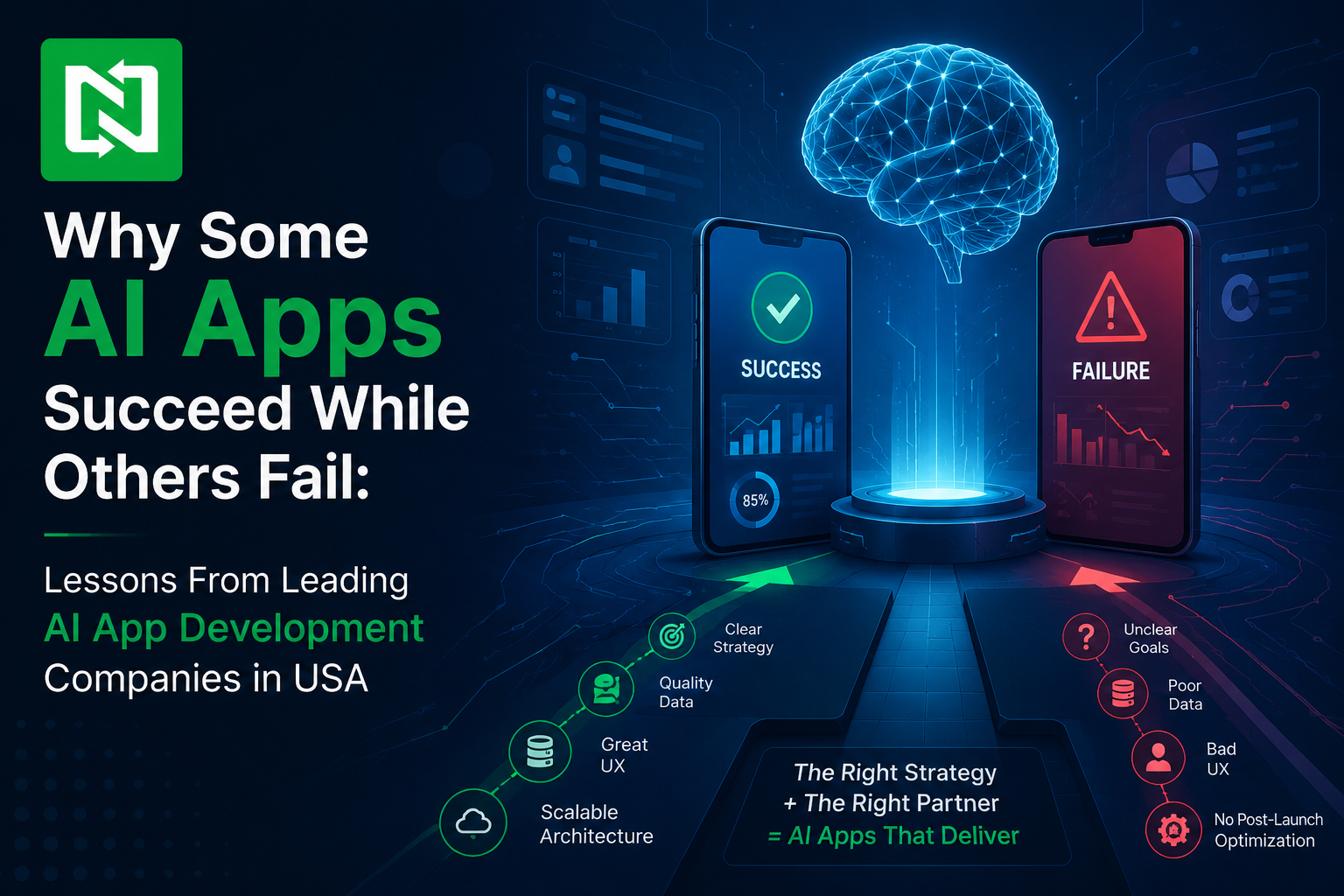
- The Real Reasons Many AI Apps Fail
- What Successful AI Apps Have in Common
- How Leading AI App Development Companies in USA Build for Success
- Common Mistakes Businesses Make Before Development Begins
- How to Choose the Right AI App Development Company in USA
- Future Trends Shaping AI App Success
- Conclusion
Introduction
Artificial intelligence has moved beyond experimentation to become a competitive advantage for businesses across industries. Yet while thousands of AI applications are launched every year, only a small percentage deliver measurable business value. The difference rarely lies in the technology alone. It often comes down to strategy, execution, user experience, and the expertise of the development partner. Working with an experienced AI App Development Company in the USA often determines whether a promising idea becomes a functioning, revenue generating product or stalls after launch. Understanding why some AI apps succeed while others fail can help businesses make informed decisions and maximize their investment in AI.
1. Why AI Apps Have Become a Business Priority
Why businesses are investing in AI
Business leaders are no longer asking whether to adopt AI, but how quickly they can integrate it into existing workflows. This shift is being driven by measurable efficiency gains, improved decision quality, and the ability to serve customers at a scale that manual processes cannot match.
Growing demand for automation
Repetitive, rules based tasks across finance, operations, and customer service are increasingly handled by intelligent systems, freeing employees to focus on higher value work.
Personalized customer experiences
AI enables businesses to tailor recommendations, content, and interactions to individual users in real time, which strengthens engagement and loyalty.
Faster business decision-making
Predictive models and real time analytics allow leadership teams to act on trends as they emerge rather than reacting after the fact. This shift from historical reporting to forward looking insight is changing how executives evaluate risk and opportunity.
Operational cost reduction
Well designed AI systems reduce manual overhead, minimize errors, and streamline processes that would otherwise require significant staffing.
Competitive market differentiation
Companies that adopt AI thoughtfully are able to launch new capabilities faster and respond to market shifts more effectively than competitors relying solely on traditional software.
Industries driving AI adoption
- Healthcare
- Finance
- Retail
- Manufacturing
- Logistics
- Education
2. The Real Reasons Many AI Apps Fail
Lack of clear business objectives
Many AI initiatives begin with enthusiasm for the technology itself rather than a specific problem to solve. Without a defined objective, teams struggle to measure success or justify continued investment.
Poor quality or insufficient data
AI models are only as reliable as the data behind them. Incomplete, inconsistent, or biased data leads to inaccurate predictions and erodes user trust quickly.
Ignoring user experience
Even highly capable AI features fail if users find them confusing or intrusive. Adoption depends on how naturally the intelligence fits into everyday workflows.
Choosing technology without solving real problems
Some organizations select AI tools because they are trending, not because they address a genuine operational need. This often results in unnecessary complexity and wasted budget.
Inadequate testing and post-launch optimization
AI systems require ongoing refinement. Treating launch as the finish line, rather than the starting point for continuous improvement, is one of the most common reasons performance declines over time.
3. What Successful AI Apps Have in Common
A clearly defined business problem
Successful AI applications are built around a specific, measurable challenge, whether that is reducing support response time or improving inventory forecasting accuracy.
High-quality data strategy
Teams that invest early in data collection, cleaning, and governance consistently produce more reliable and trustworthy AI outcomes.
Human-centered user experience
The most effective AI apps make intelligent features feel intuitive rather than complicated, guiding users instead of overwhelming them with options.
Scalable architecture
Applications built to handle growing data volumes and user demand avoid the costly rework that comes with systems designed only for initial launch conditions.
Continuous AI model improvement
Ongoing monitoring, retraining, and refinement keep models accurate as user behavior and market conditions evolve.
4. How Leading AI App Development Companies in USA Build for Success
Discovery and business analysis
Experienced teams begin with a thorough discovery phase, mapping business goals, workflows, and success metrics before writing a single line of code.
Selecting the right AI technologies
Rather than defaulting to the newest model or framework, skilled developers evaluate which combination of technologies best fits the specific use case and budget. This is where thoughtful AI application development becomes a strategic advantage rather than a technical exercise, since the right architectural decisions early on prevent costly rebuilds later.
Building scalable cloud infrastructure
Cloud native architecture allows applications to expand smoothly as data volume and user traffic increase, without requiring a complete rebuild later.
Security and compliance by design
Particularly in regulated industries such as healthcare and finance, security and compliance requirements are addressed from the earliest design stages rather than added afterward.
Continuous monitoring and optimization
Leading teams implement dashboards and feedback loops that track model performance, allowing issues to be identified and corrected before they affect users at scale.
5. Common Mistakes Businesses Make Before Development Begins
Prioritizing cost over expertise
Choosing a development partner based primarily on the lowest quote often leads to rework, missed deadlines, and lower quality outcomes.
Unrealistic project expectations
Some businesses expect AI to deliver perfect accuracy immediately, without accounting for the iterative nature of model training and improvement.
Lack of AI readiness
Organizations that have not organized their data or defined clear use cases often experience delays once development begins.
Underestimating integration challenges
Connecting AI features with existing systems, from CRMs to legacy databases, is frequently more complex than anticipated and requires careful planning. Businesses that map their existing technology stack before development begins tend to experience far fewer surprises during implementation.
No long-term AI roadmap
Treating an AI app as a single project rather than an evolving capability limits its long-term value and adaptability.
6. How to Choose the Right AI App Development Company in USA
Evaluate industry experience
A partner familiar with your industry’s regulations, workflows, and customer expectations can anticipate challenges that generic developers may overlook.
Review AI technology capabilities
Look for demonstrated expertise across machine learning, natural language processing, and cloud infrastructure rather than a narrow specialization.
Examine case studies and client success
Real examples of measurable outcomes offer a clearer picture of capability than marketing claims alone. Ask for specifics such as timelines, challenges encountered, and how those challenges were resolved.
Assess communication and development process
Transparent communication, realistic timelines, and a structured development methodology reduce risk throughout the project.
Focus on long-term partnership value
The right partner supports the application well beyond launch, helping it evolve as business needs and technology continue to change.
7. Future Trends Shaping AI App Success
Generative AI applications
Generative models are increasingly used to power content creation, customer support, and internal productivity tools across industries.
AI agents and autonomous workflows
Autonomous agents capable of completing multi-step tasks are beginning to reshape how businesses automate complex processes.
Edge AI solutions
Processing data closer to its source reduces latency and supports real time decision-making in applications such as manufacturing and logistics.
Responsible and explainable AI
As regulatory scrutiny increases, businesses are prioritizing transparency in how AI systems reach their conclusions.
Industry-specific AI platforms
Tailored AI solutions built for the specific needs of a sector, rather than generic tools, are becoming a key differentiator for forward-looking businesses. Partnering with a provider that offers enterprise AI solutions built around these emerging capabilities helps organizations stay prepared as the technology landscape continues to shift.
Conclusion
Successful AI applications are built on more than advanced algorithms. They combine strong business strategy, quality data, exceptional user experience, and expert engineering. Working with an experienced AI App Development Company in USA enables businesses to reduce risk, accelerate innovation, and create AI solutions that deliver lasting business value. If your organization is ready to explore what a thoughtfully built AI application could do for your business, reach out to Noukha to start the conversation.
Frequently Asked Questions
1. Why do many AI app projects fail?
Most failures occur because of unclear business goals, poor data quality, inadequate planning, and selecting the wrong development partner.
2. What industries benefit the most from AI apps?
Healthcare, finance, retail, manufacturing, logistics, education, and customer service are among the industries seeing the highest ROI.
3. Why should businesses work with an AI App Development Company in USA?
They provide technical expertise, strategic consulting, scalable architecture, regulatory compliance, and ongoing support throughout the AI lifecycle.