Build vs Buy Software: A Total Cost of Ownership Framework for US Businesses
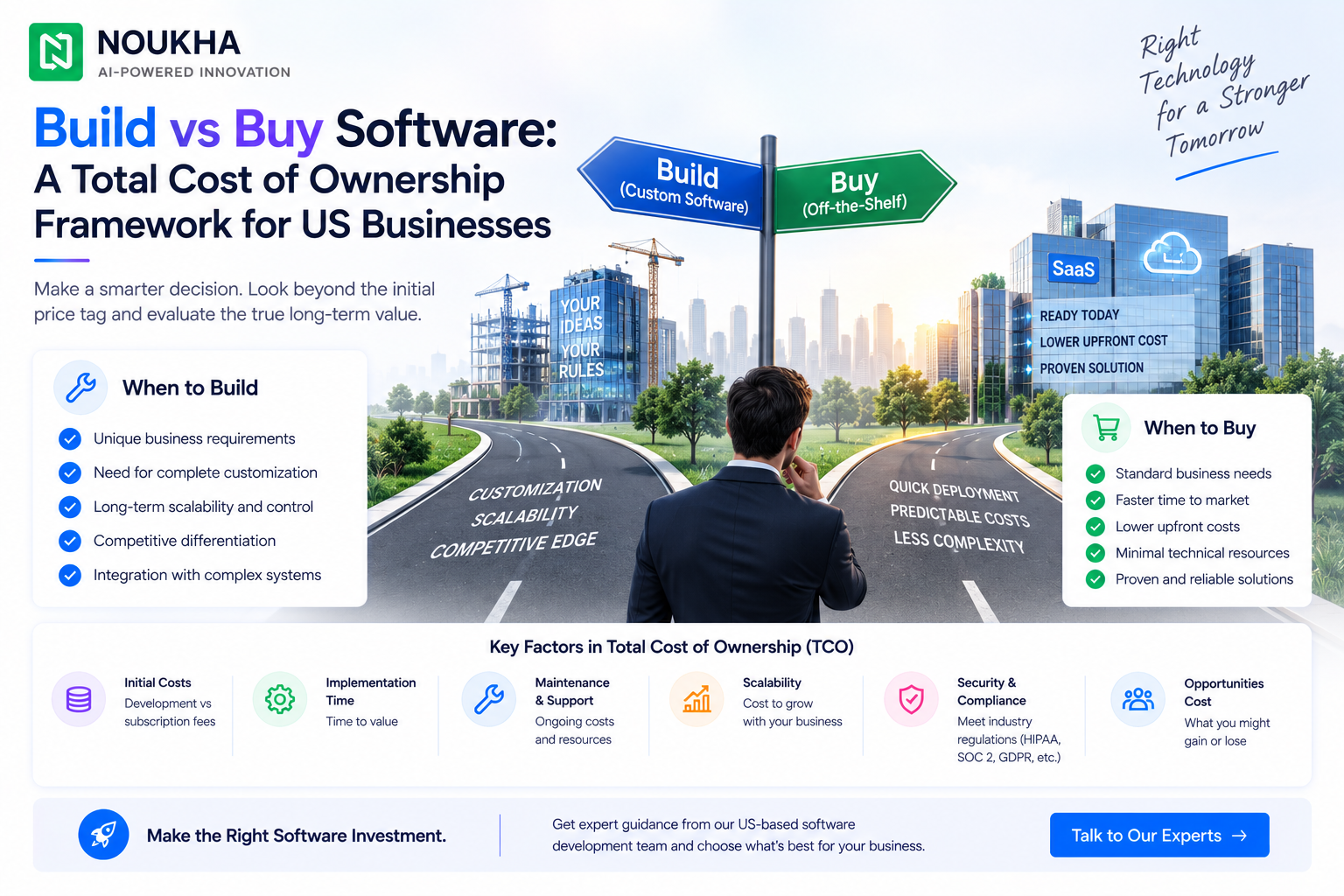
Quick answer: buy when the process is standard, speed matters more than differentiation, and the product can meet your integration, security and data requirements with limited compromise. Build when the workflow creates competitive advantage, packaged software forces costly workarounds, or long-term control over data, automation and product direction has material business value. A hybrid approach is often best: buy commodity capabilities and build the layer that makes the business distinctive.
The wrong decision usually comes from comparing a SaaS subscription with a development quote. Those numbers describe different things. A fair comparison uses total cost of ownership over a defined period and assigns value to speed, risk, flexibility and opportunity—not just licensing and coding.
What build, buy and hybrid actually mean
“Buy” means adopting a commercial platform and configuring it within the vendor’s boundaries. “Build” means creating software around the organization’s specific workflows and maintaining ownership of the product roadmap. “Hybrid” means combining purchased infrastructure or SaaS components with custom interfaces, integrations, data models or automation.
Few modern systems are built entirely from scratch. A custom application may still use cloud hosting, identity providers, payment gateways, mapping services and messaging APIs. The strategic decision is therefore about where the company needs control and where a reliable external capability is sufficient.
Start with workflow fit
Document the process as it operates today and as it should operate after improvement. Separate essential requirements from historical habits. If a package covers the essential workflow with reasonable configuration, buying may be faster and less risky. If the organization must maintain spreadsheets, duplicate entry or manual reconciliation around the package, the apparent fit may be misleading.
Pay special attention to the moments that create revenue, reduce risk or determine customer experience. A generic CRM may be perfectly adequate for contact management but unsuitable for a specialized pricing, fulfillment or compliance workflow. Building the differentiated layer can be more valuable than replacing every system.
Calculate five-year total cost of ownership
| Cost area | Buy / SaaS | Custom build |
| Initial implementation | Licensing, setup, configuration, migration and training | Discovery, UX, engineering, migration and launch |
| Recurring | Subscription, usage tiers, premium support and connectors | Cloud, monitoring, maintenance and support |
| Change | Configuration, consultants, vendor add-ons or unavailable features | Product backlog, engineering and testing |
| Exit | Data export, contract termination and replacement implementation | Handover, documentation, hosting transition and modernization |
| Hidden operational cost | Workarounds, duplicate entry and process constraints | Product ownership, governance and prioritization |
Model at least three scenarios: expected growth, faster growth and downside. SaaS cost often rises with users, transactions, storage or advanced modules. Custom-software cost may rise with scope and scale. Include internal staff time, implementation disruption and the cost of delayed capabilities in both cases.
Avoid false precision. The output should be a decision range with stated assumptions, not a single number presented as certainty. Identify which assumptions would reverse the recommendation—for example, doubling the user count or requiring a new regulated-data integration.
For a scoped custom option, review Noukha’s custom software development company in USA capabilities. The global custom software development service also explains the wider engineering approach.
Compare integration and data control
Integration quality determines whether a platform becomes a system of record or another isolated tool. Review API limits, webhooks, bulk export, identity integration, audit logs and the vendor’s roadmap for every critical connection. A feature that exists only through a fragile third-party connector should not be scored the same as a supported API.
Define who owns the data, how it can be exported, how quickly it can be recovered and what happens at contract termination. For custom software, define source-code ownership, infrastructure access, documentation and handover rights in the agreement. Control is valuable only when the organization has the operational capability to use it.
Security and compliance belong in the buying criteria
Whether software is purchased or custom-built, security practices must be evaluated as part of the lifecycle. NIST’s Secure Software Development Framework provides a common set of practices that can be integrated into development processes, while CISA guidance encourages buyers to ask vendors concrete questions about secure development and software supply-chain risk.
For SaaS, request evidence relevant to the risk: authentication controls, encryption, incident response, vulnerability management, access logging, subprocessor information and independent assurance. For a custom build, require security requirements, code review, dependency management, testing, secrets handling and remediation responsibilities in the delivery plan. Compliance labels do not replace architecture-level review.
Evaluate scalability without guessing
Buying can provide immediate operational scale when the vendor already serves comparable workloads. But confirm pricing and technical limits at your projected volume. A low entry price may become expensive after users, locations, transactions or storage grow.
Custom software can be designed around expected scale, but overengineering is wasteful. Start with realistic traffic, data growth, concurrency and availability requirements. Design clear upgrade paths and observe production behavior before investing in complexity the business may never need.
Use a weighted decision scorecard
- Workflow fit: Does the option support essential processes without costly workarounds?
- Time to value: How quickly can the organization reach a useful, adopted state?
- Five-year TCO: What are implementation, recurring, change, people and exit costs?
- Integration and data: Are critical APIs, exports, ownership and portability adequate?
- Security and compliance: Can the option produce evidence appropriate to the risk?
- Scalability: Will cost and performance remain acceptable under realistic growth?
- Strategic control: Does owning the roadmap create meaningful competitive value?
- Execution risk: Does the organization have the product ownership and change capacity required?
Assign weights before vendor demonstrations. Otherwise, impressive features can distort priorities. Score evidence, not promises, and document conditions attached to each score. A proof-of-concept should test the highest-risk assumption rather than showcase the easiest workflow.
When buying is usually the better choice
Buying is normally stronger for standardized functions such as basic payroll, commodity collaboration, common accounting or routine ticketing—provided the platform meets integration, security and regional requirements. It is also appropriate when the business must launch quickly and can adapt its process without losing differentiation.
When building is usually the better choice
Building becomes compelling when the software embodies proprietary workflow, pricing, customer experience or operational intelligence; when packages create persistent manual work; or when unique integrations and data models are central to scale. It also makes sense when a platform will become a customer-facing product rather than merely an internal tool.
If the requirement is primarily browser-based, Noukha’s web app development company in USA page can help frame architecture and delivery options.
Why hybrid often wins
A hybrid strategy preserves speed for commodity capabilities while concentrating custom investment on differentiation. A company might purchase identity, payments and communications infrastructure, then build a proprietary workflow and analytics layer. This reduces reinvention without forcing the business into a generic end-to-end process.
Hybrid architecture needs clear boundaries. Decide which system owns each data object, how failures are handled, what vendor limits apply and how components can be replaced. Without that discipline, hybrid can become a collection of fragile integrations rather than a coherent product.
Common mistakes that distort the decision
The first mistake is allowing a preferred vendor to define the requirements around its product. Write the business requirements and weights before demonstrations. The second is excluding internal labor from the buy option while including every engineering hour in the build option. Migration, administration, training and workarounds are real costs. The third is assuming custom ownership eliminates dependency; a custom product still depends on cloud services, libraries and a capable maintenance team. Make those dependencies visible in both scenarios.
A practical decision process
- Define the business outcome and the process that creates it.
- Identify commodity requirements and genuine differentiators.
- Shortlist realistic packaged and custom options.
- Build a five-year TCO model using shared assumptions.
- Test the highest-risk workflow, integration or security requirement.
- Review implementation, adoption, ownership and exit plans.
- Approve the option that best supports the business case—not the option with the longest feature list.
Frequently asked questions
Is custom software always more expensive than SaaS?
Custom software normally has a higher initial investment, but SaaS can become more expensive as users, transactions, modules and integration costs grow. Compare the same scope over several years, including operational workarounds and change costs.
How long should the TCO period be?
Three to five years is useful for many business systems. Use a shorter period for rapidly changing experiments and a longer period for core operational platforms with significant migration cost.
Who should own a custom software product internally?
A named business product owner should control outcomes, priorities and acceptance. The development partner can lead delivery, but the organization must retain decision ownership and access to code, infrastructure, documentation and data.
Can we start with SaaS and build later?
Yes. Design for portability from the beginning: maintain clean data, document integrations, understand export options and avoid unnecessary dependence on proprietary workflows. A staged approach can validate demand before custom investment.
Final recommendation
Buy standard capabilities when the market already solves them well. Build the workflows that differentiate the business or remove material operational friction. Use a hybrid model when it lets the organization own the valuable layer while relying on proven infrastructure underneath. Above all, compare evidence through a common five-year framework rather than treating subscription price and development cost as equivalent.