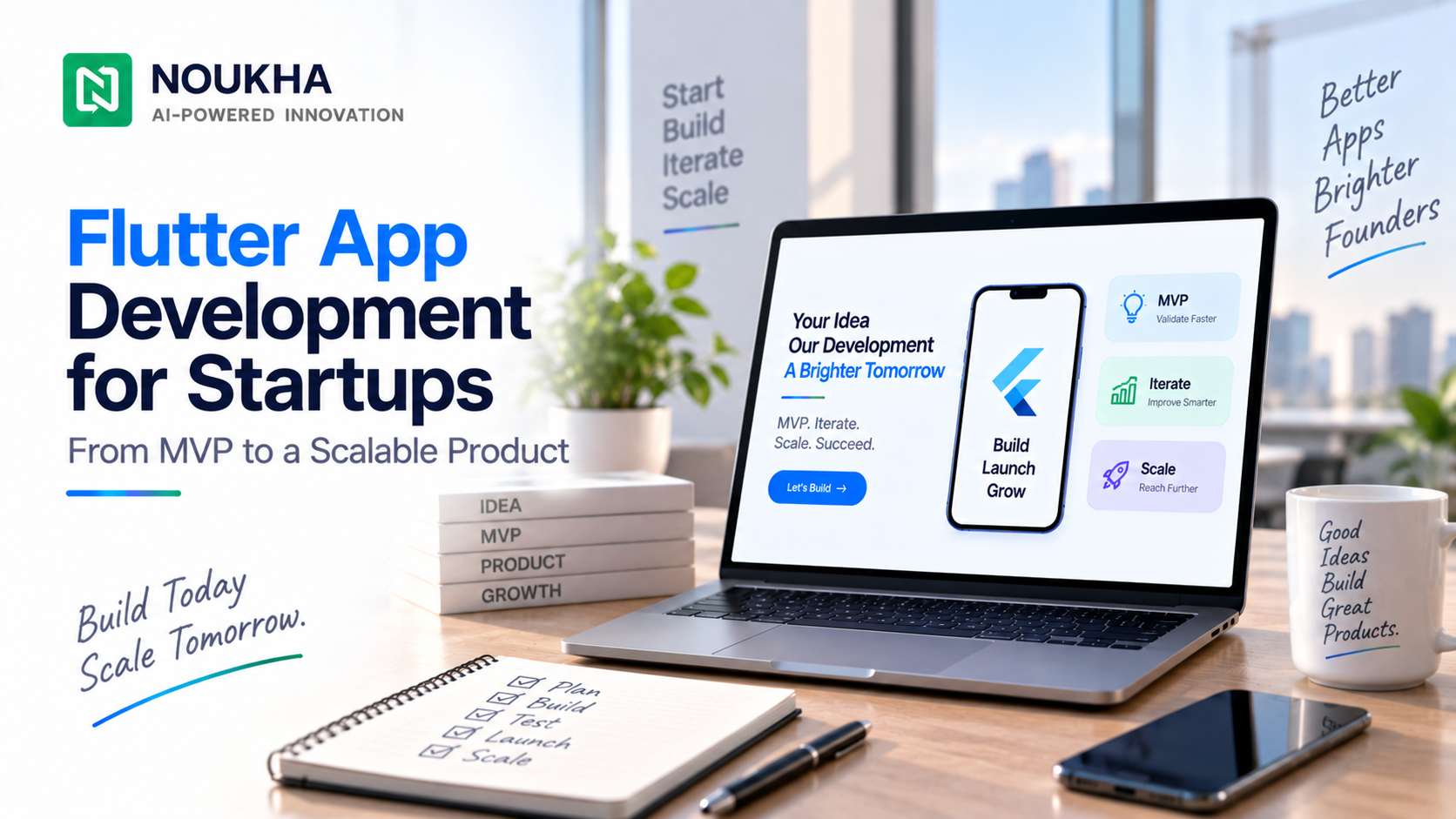
Flutter App Development for Startups From MVP to a Scalable Product
Flutter can help a startup launch on Android and iOS from one application codebase, but the framework does not decide whether the product will scale. Scalability comes from clear boundaries in the code, a suitable backend, disciplined testing and reliable release operations. These choices should begin in the MVP even when the first release is intentionally small.
The goal of an MVP is to test the riskiest product assumption with real users. It should be small enough to deliver quickly and strong enough to produce trustworthy evidence. A rushed prototype with fragile authentication, unclear analytics or manual data fixes can make user feedback difficult to interpret.
Startups considering a delivery partner can review Noukha’s Flutter app development company in USA page for capabilities and project planning. The sections below explain how to structure the journey from first release to growth.
Choose Flutter for the right reasons
Flutter is a strong option when the startup needs Android and iOS at the same time, values a consistent branded interface and expects frequent product iteration. One client codebase can reduce duplicated feature work and keep behavior aligned across platforms. It does not remove the need for platform-specific testing or occasional native integration.
A single-platform native app may be simpler when the early market is concentrated on one platform or the product depends heavily on new platform-specific hardware capabilities. React Native may fit a team that already has deep JavaScript and React experience. Framework selection should follow product, team and integration constraints.
Define the MVP around a learning goal
Write one statement describing what the first release must prove. A marketplace may need to prove that customers can complete a transaction with a limited group of providers. A field application may need to prove that workers can finish a job without reliable connectivity. This statement becomes the filter for feature decisions.
Include the complete path needed to test the goal. Authentication, notifications, administration and analytics may feel secondary, but they can be essential to operating and measuring the MVP. Remove extra variants and advanced personalization before removing the controls that make the experiment reliable.
Noukha’s startup app development company in USA page provides additional guidance for planning early product delivery.
Design the app for change
Flutter’s official architecture guidance recommends separating concerns into UI and data layers, with views, view models, repositories and services taking distinct responsibilities. A startup does not need an elaborate architecture, but it benefits from keeping interface code separate from business rules and data access.
This separation makes change safer. The team can replace an API, modify storage or redesign a screen without rewriting unrelated behavior. It also allows unit tests to cover business decisions without depending on a device or rendered interface.
Build a reusable interface system
Create a small set of reusable components for typography, color, spacing, buttons, inputs, navigation and feedback states. The system should support loading, empty, error and offline conditions, not only ideal content. Reusable widgets reduce visual drift as the team adds features.
Platform conventions still matter. Navigation, permissions, text input and system feedback should feel appropriate on Android and iOS. Flutter enables a shared implementation, but the design should respect the expectations users bring from each device.
Keep the backend independent of the mobile client
The mobile app should access business data through documented services rather than relying on assumptions that exist only in client code. Define authentication, permissions, validation, pagination and error responses at the API boundary. This allows future web tools, integrations and new clients to use the same business rules.
Choose managed backend services when they reduce operational work without creating an unacceptable limitation. A startup may begin with managed authentication, storage and notifications, then introduce specialized services as usage and product requirements become clearer. Record the conditions that would trigger a change.
Plan testing before the feature list grows
Flutter distinguishes unit tests, widget tests and integration tests. Unit tests cover functions and classes. Widget tests cover individual interface components. Integration tests exercise a complete workflow or a large part of the application. A healthy test strategy uses each level where it provides the most useful feedback.
Prioritize tests for revenue, data integrity, authentication and other high-impact workflows. Add regression coverage whenever a defect escapes into a shared build or production. Automated tests protect iteration speed because the team can change existing code without manually repeating every previous scenario.
Prepare for unreliable networks and devices
Mobile products run under conditions that office development environments do not reproduce. Requests time out, users switch networks, the operating system suspends the app and devices have different memory limits. Define how the app communicates progress, retries safe operations and preserves user input.
Offline support is an architectural decision. If users must continue working without connectivity, plan local storage, conflict resolution, synchronization and security from the start. Adding offline behavior after workflows are complete can require changes across the interface, data model and backend.
Measure performance with real metrics
Flutter’s performance guidance recommends measuring before attempting optimization. Track startup time, frame rendering, memory, application size, network latency and failure rates on representative devices. A smooth experience depends on the full system, including APIs and media handling, not only the Flutter rendering layer.
Define budgets for critical screens and workflows. Test lower-range supported devices and realistic data volumes. Monitor production crashes and slow interactions by application version so the team can confirm whether a release improved or reduced quality.
MVP to scale roadmap
| Stage | Product focus | Engineering focus |
| Prototype | Confirm workflow and usability | Disposable experiments and technical spikes |
| MVP | Prove one business assumption | Clean boundaries analytics security and core tests |
| Growth | Improve retention and expand workflows | Performance automation monitoring and backend capacity |
| Scale | Support larger teams markets and usage | Modular ownership resilience compliance and cost control |
Build release operations early
Use automated builds and repeatable environment configuration before the team is under launch pressure. Separate development, testing and production settings. Protect signing credentials and store access. A release checklist should cover versioning, migrations, analytics, privacy declarations, monitoring and rollback or hotfix procedures.
Feature flags can help the team release code without exposing every feature immediately. They support controlled testing and safer rollout, but they also need ownership and cleanup. Old flags can make behavior difficult to understand if they remain indefinitely.
For overall project budgeting, use Noukha’s mobile app development cost in USA guide. Startups comparing other cross-platform options can also read Flutter vs React Native in 2026.
Know when the architecture needs to change
- A feature area changes frequently and causes unrelated regressions
- Build and test time slows enough to delay normal delivery
- Several developers edit the same central files every sprint
- One backend service becomes a reliability or cost bottleneck
- New markets introduce different data or compliance requirements
- The team cannot measure which component causes failures
Do not redesign solely because user numbers reached an arbitrary milestone. Change architecture when measurements show a constraint or when the next product requirement cannot be delivered safely within the current structure. Incremental improvements usually carry less risk than a complete rewrite.
Plan the team as the product grows
An early team may share responsibility for product, interface, Flutter development, backend work and testing. Growth creates a need for clearer ownership. Assign maintainers to major areas, document important decisions and review changes across boundaries. New developers should be able to run the app, understand environments and ship a safe change without relying on undocumented knowledge.
Businesses that need broader mobile engineering support can review Noukha’s mobile app development company in USA page.
Frequently asked questions
Is Flutter suitable for a startup MVP
Yes when the startup needs Android and iOS and the required integrations are supported well. The team should still compare Flutter with a single native platform or React Native based on product and team constraints.
Does one Flutter codebase mean no platform specific work
No. Store requirements permissions notifications payment flows and some hardware integrations still require platform-specific configuration testing or native code.
Should an MVP use production quality architecture
It should use enough structure to protect the core workflow data and learning goal. Avoid unnecessary complexity but keep interface business logic and data access separated so the product can change safely.
When should a startup rebuild its Flutter app
Rebuild only when evidence shows that incremental change cannot meet important product performance security or maintainability requirements. A growing user count alone is not a reason to rewrite.
Final recommendation
Use Flutter to reduce duplicated client work, then invest the saved effort in product learning, testing and reliable operations. Define a narrow MVP, keep the architecture easy to change and measure real performance as usage grows. These practices allow the first release to remain useful while the product and team mature.