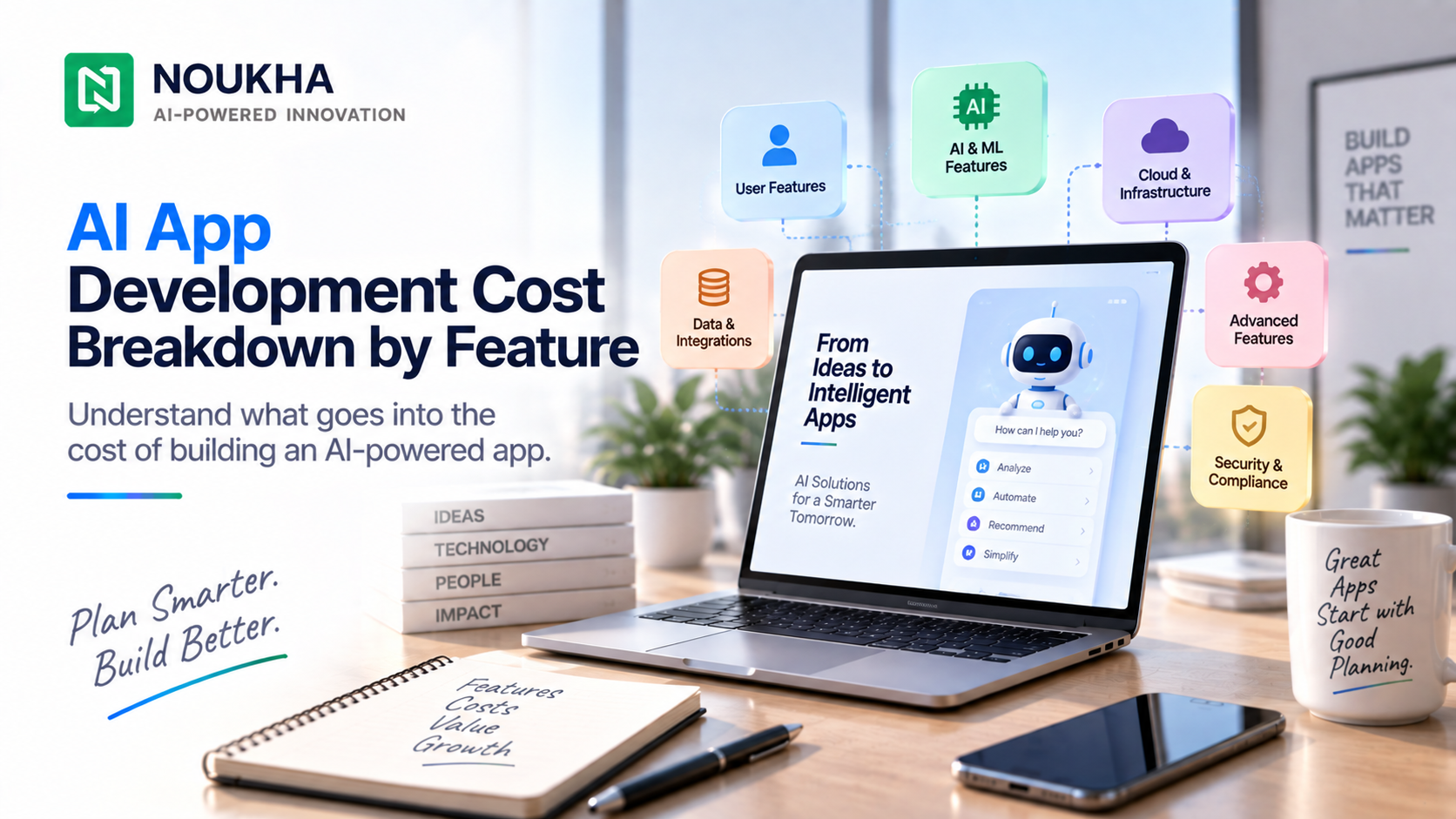
AI App Development Cost Breakdown by Feature
AI features that look similar on screen can require very different work behind the interface. A chatbot that answers from approved documents is not estimated like an assistant that takes actions in business systems. A product recommendation panel is not estimated like a model trained on proprietary behavior data. Cost follows the data, evaluation, integrations and consequences of an incorrect result.
A useful budget separates the normal application from the AI capability. The application still needs user accounts, permissions, workflows, backend services, administration and monitoring. The AI layer adds model access, data preparation, retrieval or training, evaluation, safety controls and usage costs. Estimating both layers prevents an inexpensive model demo from being mistaken for a production product.
For the broader planning ranges and cost drivers, start with Noukha’s AI app development cost USA guide. This article focuses specifically on how individual AI features change the estimate.
Start with the business task
Define the action the feature must improve and the evidence that will show success. A support assistant may aim to increase first-contact resolution. A recommendation system may aim to improve product discovery. A vision feature may reduce manual inspection time. The target determines which data is needed and how output quality should be measured.
Write down unacceptable outcomes as well. A creative writing assistant can tolerate variation. A system that summarizes a clinical document or approves a financial action needs stronger validation, human review and auditability. The cost of error changes the engineering approach.
Cost components shared by AI features
- Product design and the surrounding web or mobile workflow
- Data collection cleaning labeling and access controls
- Model selection prompts retrieval logic or custom training
- Integrations with databases documents and business systems
- Evaluation datasets quality thresholds and regression tests
- Safety privacy security and human review controls
- Production monitoring model updates and usage charges
Do not estimate the model in isolation. A feature becomes useful only when it can access the right context, respect user permissions, return results in the workflow and recover when a provider or integration fails.
Chatbots and knowledge assistants
A basic chatbot uses a hosted model and a defined prompt. A production knowledge assistant usually adds document ingestion, search, retrieval, citations, permission filtering, conversation history, feedback and monitoring. The size and condition of the knowledge base often influence the schedule more than the chat interface.
Budget increases when the assistant must answer from frequently changing content, distinguish access levels or support several languages. Evaluation also requires realistic questions, expected answers and rules for refusing unsupported requests. Without that test set, teams can improve individual examples while overall reliability remains unknown.
AI workflow automation and agents
Automation becomes more expensive when the AI can change records, send messages, create orders or trigger payments. Each action needs authentication, authorization, validation, error handling and an audit trail. Human approval may be required before high-impact actions are executed.
A reliable agent also needs limits. Define which tools it can use, what data each tool exposes, how many steps it may take and what happens when a task cannot be completed. The system should be designed for partial failure because external services can be slow, unavailable or return unexpected data.
Businesses evaluating action-oriented products can review Noukha’s AI agent development company in USA page. Projects centered on language and content generation may also use the generative AI development company in USA resource.
Recommendation and personalization systems
A rules-based recommendation feature can be delivered quickly when product attributes and business rules are already available. Machine learning personalization needs sufficient behavioral data, reliable event tracking and a method for comparing the new ranking against the current experience.
Cold-start behavior must be planned for new users and new products. The system may combine popular items, declared preferences, contextual signals and editorial rules until enough interaction data is available. Ongoing cost includes feature pipelines, experimentation, monitoring and periodic retraining or recalibration.
Computer vision features
Vision projects range from using a general model to classify common objects to training a specialized system for inspection or diagnosis support. The estimate depends on image quality, environmental variation, annotation requirements, inference speed and whether processing occurs on a device or in the cloud.
A prototype built from ideal images does not prove production performance. Evaluation data should represent different devices, angles, lighting, backgrounds and edge cases. If the output influences safety, healthcare or financial decisions, subject-matter review and stronger documentation add necessary work.
Feature comparison
| Feature | Main cost driver | Common hidden work |
| Knowledge assistant | Content quality and retrieval accuracy | Permissions citations and evaluation set |
| Workflow agent | Number and impact of actions | Approvals audit trails and failure recovery |
| Recommendations | Behavior data and experimentation | Event quality cold start and monitoring |
| Computer vision | Labeled images and environment variation | Annotation edge cases and inference performance |
Hosted models and custom models
Hosted model APIs can reduce initial engineering time because the provider operates the model infrastructure. The application still needs prompts, context management, evaluation, security and cost controls. Usage becomes an operating expense that changes with the number and size of requests.
Custom training may be justified when the task depends on proprietary patterns, strict latency, offline operation or control that a general service cannot provide. It also introduces experimentation, infrastructure, deployment and model lifecycle work. Many products should begin with a hosted model or a smaller proof of concept and move toward customization only when evidence supports it.
Data readiness changes the budget
Teams often assume that existing data is ready because it exists in a database or document library. In practice, records may be duplicated, inconsistent, incomplete or inaccessible under current permissions. Create a data inventory before committing to a feature scope. Identify the source, owner, quality issues, retention rules and permitted use for each dataset.
For retrieval systems, document structure and metadata affect search quality. For recommendations, event definitions and user identity resolution affect learning. For vision, labeling guidelines and reviewer agreement affect the training signal. These tasks belong in the project estimate.
Evaluation is part of development
NIST’s AI Risk Management Framework emphasizes managing AI risk throughout design, development, deployment and use. A production team should translate that principle into measurable tests. Define accuracy or task-success metrics, create representative examples, record failure categories and set thresholds for release.
Keep the evaluation set separate from ad hoc development examples. Run it whenever prompts, retrieval settings, models or tools change. For user-facing generative features, combine automated checks with human review because a single score may not capture usefulness, groundedness and tone.
Plan recurring AI costs
- Model requests and the amount of input and output processed
- Vector search databases or feature storage
- Data pipelines document processing and scheduled indexing
- Monitoring logs evaluation runs and quality review
- Human escalation and content or safety moderation
- Model provider changes retraining and regression testing
Forecast low, expected and high usage. Add limits for unusually large requests, repeated retries and automated loops. Review cost per completed business task rather than cost per model call alone. A cheaper call can be more expensive if low-quality results cause repeated attempts or manual correction.
Teams building the full product around these capabilities can review Noukha’s AI app development company in USA page. The mobile app development cost in USA guide helps estimate the non-AI parts of a mobile product.
Frequently asked questions
Which AI feature is usually the least expensive
A narrowly scoped feature that uses a hosted model and clean existing data is usually the quickest to validate. The surrounding workflow evaluation and security requirements still determine whether it is ready for production.
Why does a chatbot cost more than an API demo
A production chatbot needs trusted content retrieval permissions evaluation monitoring feedback handling and integration with the product. The model response is only one component.
Is custom model training always better
No. Custom training adds cost and lifecycle responsibility. It is useful when a general model cannot meet a defined requirement and the organization has enough suitable data to improve the result.
How can a company control AI operating cost
Set request limits monitor usage by feature and customer cache safe repeated work and test smaller models for suitable tasks. Measure cost against successful outcomes rather than raw request volume.
Final recommendation
Estimate each AI feature from its business task, data, evaluation requirements, integrations and failure consequences. Validate one valuable workflow before expanding the feature set. This produces a budget tied to observable performance and makes recurring model costs easier to control.